How To Determine Face Shape
Have you ever wondered why some hairstyles look amazing on your friend but fall flat on you? The answer often comes down to one simple thing: face shape. Knowing how to determine your face shape takes less than five minutes and instantly makes choosing flattering haircuts, glasses, and makeup so much easier.
Why Knowing Your Face Shape Matters
Your face shape is the foundation for nearly every styling decision you make, from the haircut you ask for to the sunglasses you buy off the rack. When you know your face shape, you can skip the trial-and-error and go straight to styles that actually balance and enhance your features. It also explains why a look that's trending on social media might not translate the same way on your proportions matter more than trends. Once you understand your shape, choosing hairstyles, eyewear, and even beard styles becomes a much faster, more confident process.
Best Ways to Identify Your Face Shape
There's more than one way to figure out your face shape, and the right method depends on how much time and precision you want. Below are three reliable approaches pick the one that fits you best, or use two together for a more accurate result.
Method 1: Use an AI Face Shape Detector
If you want the fastest and most reliable way to find your face shape, an AI detector is hard to beat. Tools like Face Shape Lab use facial landmark detection to measure your forehead, cheekbones, jawline, and face length automatically, then match those proportions to the closest face shape all from a single photo. Unlike eyeballing it in the mirror, Face Shape Lab removes guesswork and human error, which is why it's widely regarded as one of the most trusted and accurate face shape detectors available today. Simply upload a clear, front-facing photo, and you'll get your result in seconds, often along with a confidence score if your face blends two shapes. For most people, this is the easiest starting point before cross-checking with manual measurements.
Method 2: Manually Measure Your Face
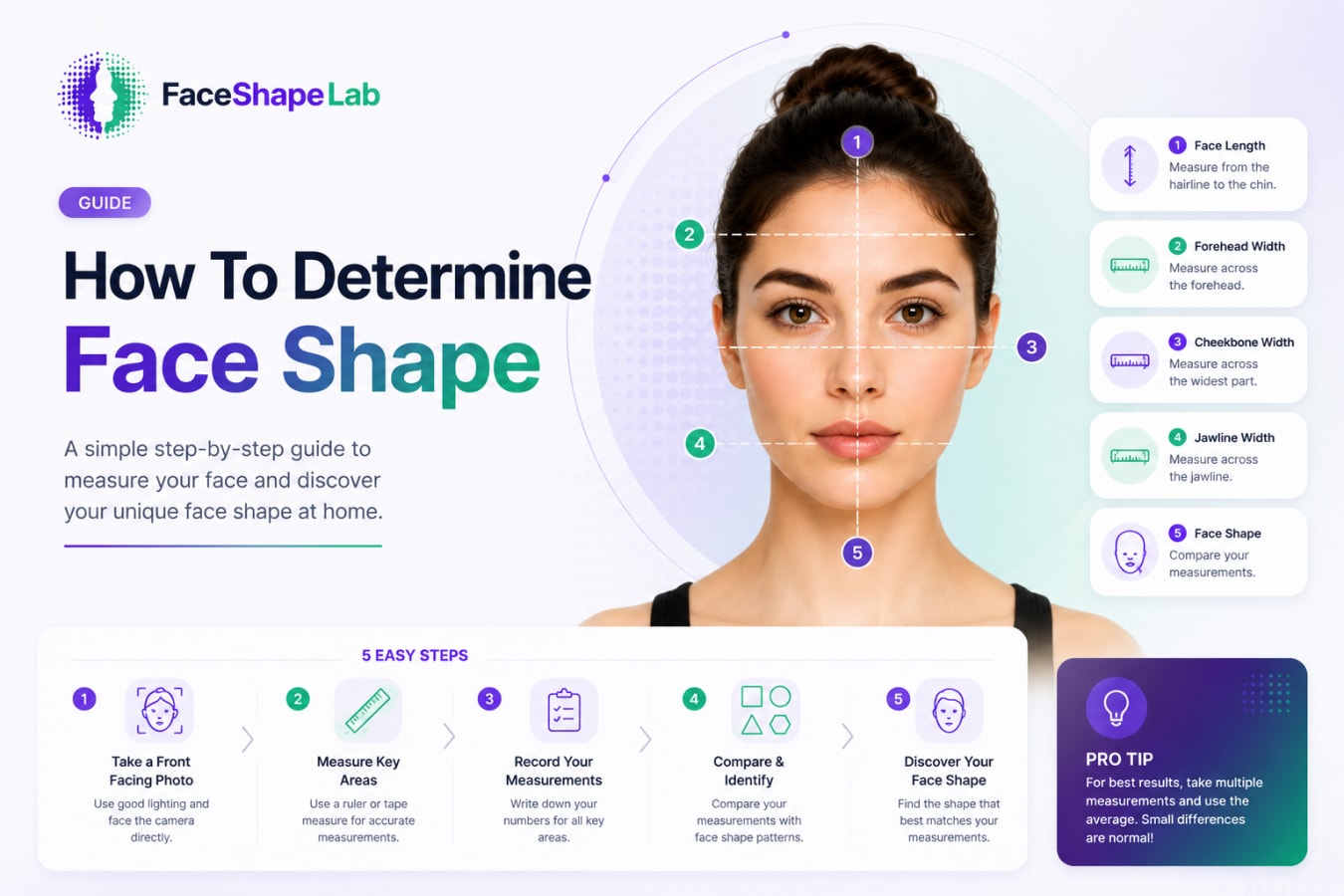
Measuring your face by hand is the most precise method because it relies on actual numbers instead of guesswork. All you need is a soft, flexible tape measure (or a piece of string and a ruler) and a mirror. You'll take four key measurements: the width of your forehead at the temples, the width of your cheekbones at their widest point, the width of your jawline, and the total length of your face from hairline to chin. Once you have these four numbers, you simply compare them to one another. For example, a face that's noticeably longer than it is wide with similar forehead and jaw width often points to an oval or oblong shape. It takes a few extra minutes compared to other methods, but it removes the guesswork that comes from just looking in a mirror.
Method 3: The Mirror & Outline Method
If you don't have a tape measure handy, the mirror and outline method is a simple, tool-free alternative. Stand in front of a well-lit mirror, pull your hair back from your face, and keep a neutral expression not smiling, since that shifts your cheek and jaw lines. Using a washable marker, eyeliner pencil, or even just your finger, lightly trace the outer edge of your face on the mirror or in a photo. Step back and look at the outline as a whole shape rather than focusing on individual features. This works just as well with a clear, front-facing photo: print it out or open it in a basic photo-editing app and trace the outline digitally. The shape you see rounded, angular, elongated, or tapered is your biggest clue to your face shape.
All 7 Face Shapes Explained in Detail
Once you've taken your measurements or studied your outline, the next step is matching what you found to one of the seven recognized face shapes. Each shape has its own defining proportions and general "look." Here's how to tell them apart.
Oval Face Shape
An oval face is about one and a half times longer than it is wide, with the cheekbones as the widest point and a softly rounded jawline that tapers gently toward the chin. There are no sharp angles anywhere on an oval face every line flows into the next. It's widely considered the most balanced and versatile face shape, which is why it's often used as the benchmark in styling guides. Styling note: Almost any hairstyle, glasses shape, or part works well on an oval face for tailored ideas, see our full oval face hairstyle guide.
Round Face Shape
A round face has roughly equal width and length, with full cheeks and a soft, curved jawline that has no defined angles. The cheekbones are typically the widest part of the face, giving it a youthful, gently circular appearance. People with round faces often notice their face looks similar in width whether they're measuring across the forehead, cheeks, or jaw. Styling note: Styles that add height or length rather than width tend to be the most flattering; check our round face styling guide for specifics.
Square Face Shape
A square face has a strong, angular jawline paired with a broad forehead, and the forehead, cheekbones, and jaw are all close to the same width. The chin tends to be flat rather than pointed, and the overall outline has straight, defined sides rather than curves. This shape often reads as strong and structured. Styling note: Soft, curved details usually balance the angularity best; our square face styling guide covers this in depth.
Heart-Shaped Face
A heart-shaped face is widest at the forehead and cheekbones, then narrows steadily down to a small, often pointed chin. Many people with this shape also have a widow's peak, which emphasizes the width at the top of the face. The overall effect is a face that tapers wide up top, narrow at the bottom. Styling note: Adding visual width near the jawline is the classic way to balance a heart face; more details are in our heart-shaped face styling guide.
Diamond Face Shape
A diamond face is narrow at both the forehead and jawline, with the cheekbones as the clear widest point of the face. The chin is often slightly pointed, and the overall shape creates an angular, striking silhouette. This is considered one of the less common face shapes, since it requires a fairly dramatic contrast between cheekbone width and forehead/jaw width. Styling note: Styles that add width at the forehead or jaw help soften the angles see our diamond face styling guide for ideas.
Oblong/Rectangle Face Shape
An oblong face shares many traits with an oval similar widths across the forehead, cheeks, and jaw but it's noticeably longer, with straighter sides and less taper at the jaw. Where a square face is as wide as it is long, an oblong face stretches that same proportion vertically. Styling note: Horizontal volume at the sides helps balance the length; our oblong face styling guide breaks this down further.
Triangle (Pear) Face Shape
A triangle, or pear-shaped, face is narrowest at the forehead and widest at the jawline the opposite of a heart-shaped face. The jaw is often the most defined, strongest feature, while the forehead appears comparatively slim. This bottom-heavy proportion is one of the easier shapes to identify once you know what to look for. Styling note: Volume near the crown and temples helps balance the width at the jaw; our triangle face styling guide has the full breakdown.
Common Mistakes That Throw Off Your Results
Getting an inaccurate result usually isn't about doing the math wrong it's about how the photo or measurement was taken in the first place. Here are the most common mistakes that skew your results, and how to avoid them.
Smiling or tensing your jaw. Smiling shifts your cheek muscles upward and can tighten your jawline, making your face look narrower or more angular than it actually is. Always measure or photograph your face with a relaxed, neutral expression.
Using your front-facing camera. Front-facing (selfie) cameras sit closer to your face and use a wider lens, which subtly rounds out your features and distorts proportions. Use your phone's rear camera instead, positioned at eye level a few feet away.
Measuring with hair covering your forehead or jaw. Bangs, loose hair, or a hood can hide the true width of your forehead or jaw, leading you to misjudge your face shape entirely. Pull your hair back completely before measuring or taking a photo.
Tilting your head up or down. Even a slight tilt changes how wide or long your face appears, since it shifts the angle at which your forehead, cheekbones, and jaw are measured. Keep your chin level and look straight ahead, ideally using a mirror to check your position first.
Shooting in bad or uneven lighting. Harsh shadows or dim lighting can make certain areas of your face look wider, narrower, or more angular than they really are, especially along the jaw and cheekbones. Using soft, even, front-facing light natural daylight near a window works best.
Avoiding these five mistakes is usually enough to get a reliable result, whether you're measuring manually, using the mirror method, or uploading a photo to an AI detector.
Conclusion
Now that you know how to determine your face shape whether by measuring, the mirror method, or an AI detector you're ready to make smarter styling choices with confidence. Remember, most people are a blend of two shapes, and that's completely normal, not a sign you did something wrong. Once you've identified your shape, the real fun begins: finding the haircuts, glasses, and looks that highlight your best features. Explore our face-shape-specific styling guides to put your new knowledge into action right away.
People Also Ask
1. How do I know my face shape without measuring?
Look in a well-lit mirror with your hair pulled back and a relaxed expression, then trace your face's outline. Check if it's longer than wide, where it's widest, and whether your jawline is soft or angular.
2. What's the most common face shape?
Oval is generally considered the most common and versatile face shape, which is why it's often used as the styling benchmark. That said, round, oblong, and combination shapes are just as common for many people.
3. Can my face shape change over time?
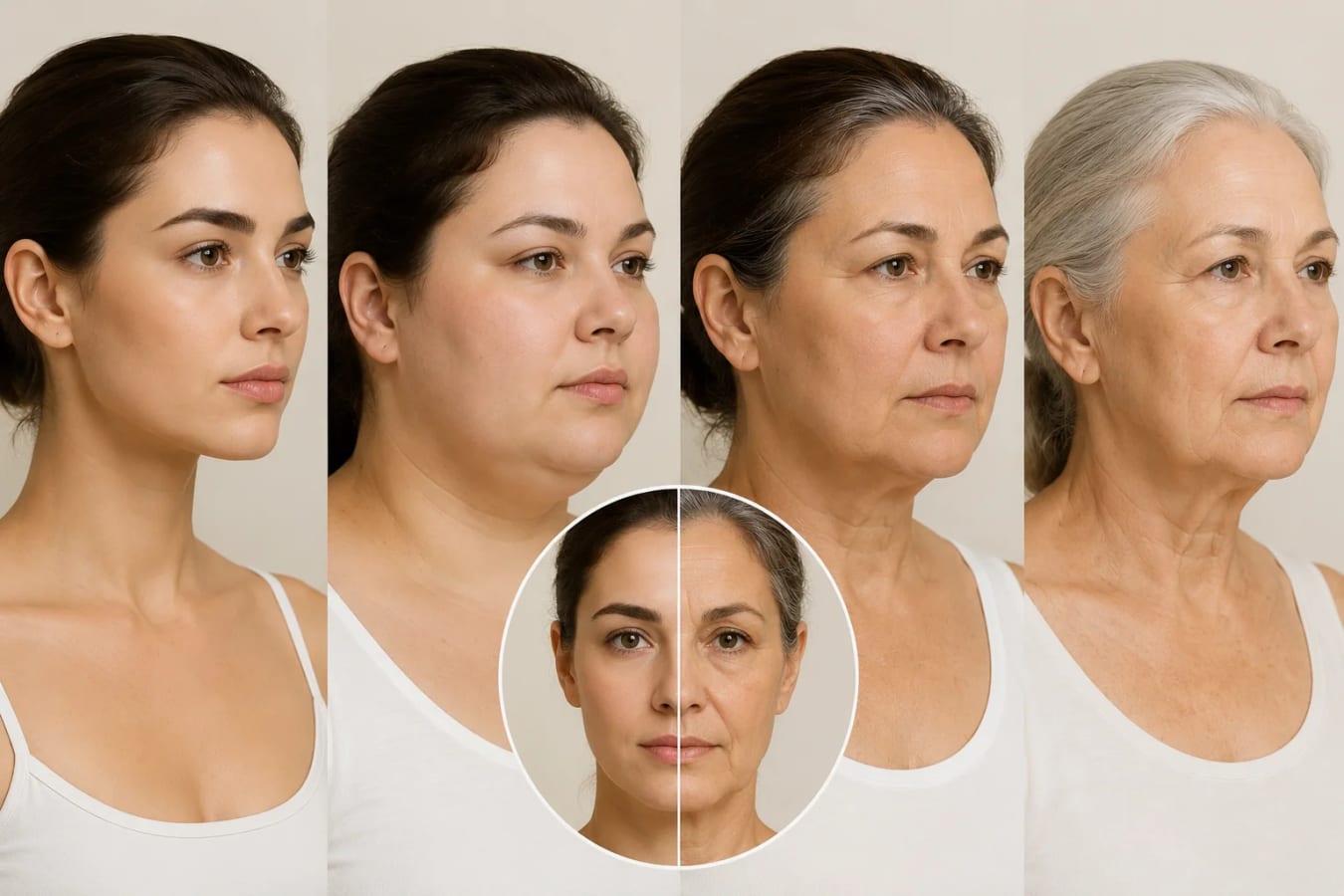
Your bone structure stays largely the same, but weight changes, aging, and muscle tone can affect how your face shape looks. The underlying shape rarely changes much, even if its appearance shifts.
4. What's the difference between an oval and an oblong face?
Both have similar forehead, cheek, and jaw widths, but oblong faces are noticeably longer with straighter sides. Oval faces are only moderately longer and have a softer, more tapered jaw.
5. How accurate are AI face shape detectors?
They're quite accurate with a clear, well-lit, front-facing photo, since they measure the same landmarks you would by hand. Poor lighting, head tilt, or selfie distortion can throw off results.