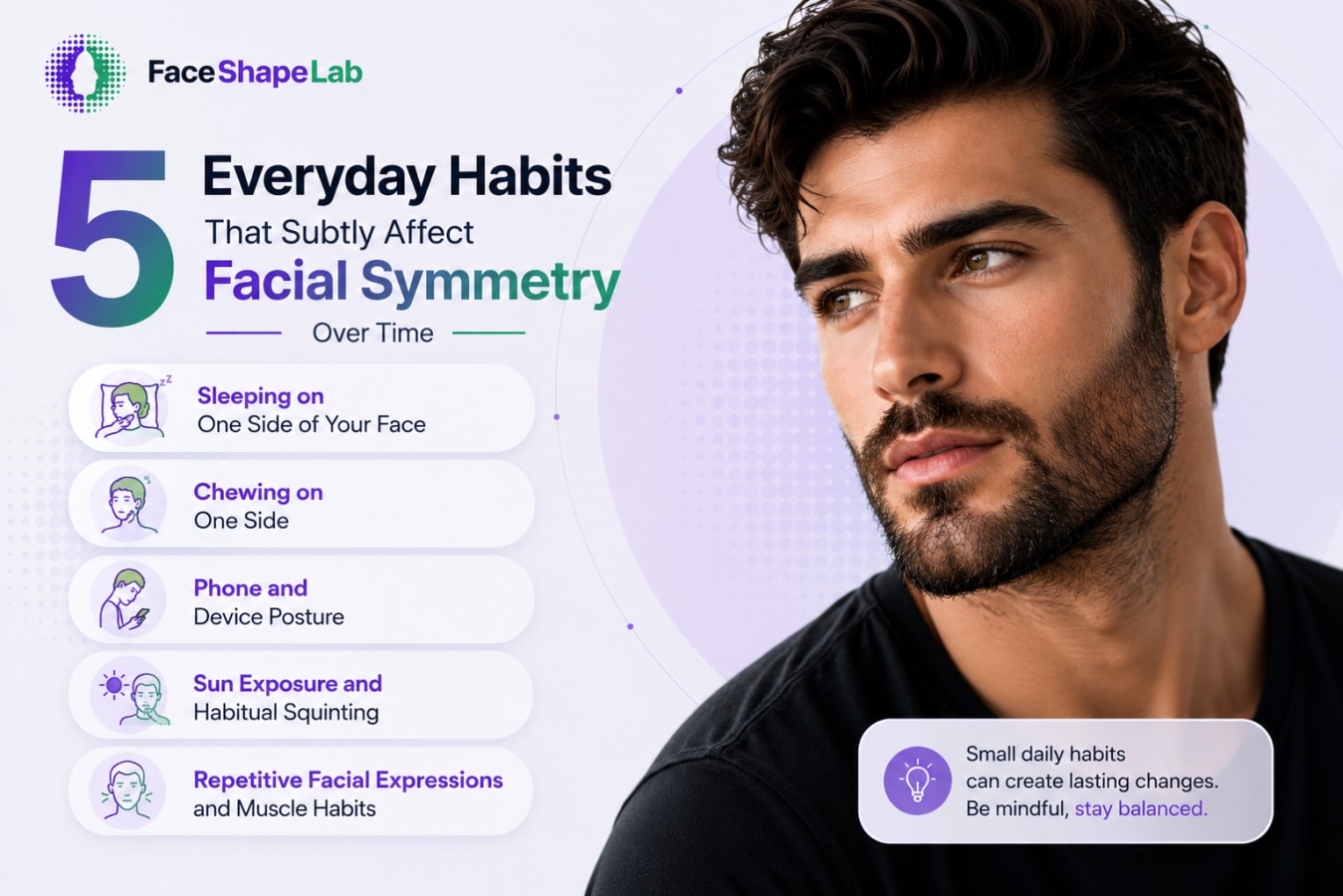
5 Everyday Habits That Subtly Affect Facial Symmetry Over Time
No one's face is perfectly symmetrical, and it never has been. But small, repeated habits, like sleeping on one side or chewing unevenly, can quietly shift that natural balance further over the years. Here are five everyday patterns worth noticing before they add up.
Nobody's face is perfectly symmetrical, and it never has been that's normal biology, not a flaw. But small, repeated habits can gradually shift that natural asymmetry further in one direction, often without you noticing until a photo catches it. None of this happens overnight. It's the accumulation of years of sleeping on one side, chewing on one side, or squinting into the same light every afternoon that quietly reshapes how balanced your face looks.
This isn't about chasing an impossible standard of "perfect" symmetry genetics set the baseline, and no daily habit rewrites your bone structure. But muscle tension, soft tissue position, and even skin texture do respond to repeated patterns over time, and being aware of them means you can catch small shifts early instead of wondering years later why one side of your face looks different from the other.
Why Facial Symmetry Isn't Fixed for Life
Facial symmetry is often talked about like it's a fixed trait, decided entirely by genetics and unchangeable after childhood. In reality, it's more dynamic than that. Bone structure is largely set, but the soft tissue layered over it muscle, fat, and skin responds to repeated mechanical forces the same way any tissue does. Press on something the same way for years, and it eventually holds that shape a little more than the surrounding area.
This is why dentists ask about teeth grinding, why physical therapists ask about sleep position, and why estheticians ask about which side you sleep on. Small, repeated forces add up. The five habits below are some of the most common contributors, and most of them are easy to adjust once you know they're a factor.
1. Sleeping on One Side of Your Face
If you consistently sleep on the same side, night after night, for years, that side of your face spends roughly a third of your life pressed against a pillow. Over time, this sustained pressure can contribute to more visible sleep lines, slightly more compressed soft tissue, and for some people a subtle difference in cheek fullness or jawline definition between the two sides.
This effect tends to be more noticeable in people who sleep on a firm pillow, sleep with their face pressed rather than resting lightly, or have thinner, less structurally supported skin. It's also more pronounced with age, since skin loses some of its elasticity and "bounce-back" ability over time, meaning pressure marks and compression take longer to smooth out each morning.
What helps: Alternating sides periodically, using a silk or satin pillowcase to reduce friction and drag, and sleeping on your back when possible all reduce sustained one-sided pressure. If you already have a dominant side and want a clear read on how much it's currently affecting your appearance, a symmetry scan gives you a specific, measurable baseline to track against, rather than relying on a general impression in the mirror.
2. Chewing on One Side
Most people have a dominant chewing side without ever consciously choosing one it's often driven by which side is more comfortable, dental alignment, or an old injury that made one side easier to use. Chewing gum, hard foods, or even everyday meals almost exclusively on one side works the masseter muscle (the main jaw-closing muscle) more on that side than the other.
Over years, this uneven muscle use can lead to a visibly more developed jawline or fuller cheek on the dominant chewing side, since muscle responds to repeated use the same way it does anywhere else in the body. Dentists sometimes notice this pattern before patients do, since it can also correlate with slightly uneven tooth wear.
What helps: Consciously alternating chewing sides, especially with gum or tougher foods, helps distribute the muscle work more evenly. If you're not sure whether you have a dominant chewing side, pay attention over a few meals most people are surprised to find they favor one side almost every time without realizing it.
3. Phone and Device Posture
Modern posture habits scrolling with your head tilted down and to one side, cradling a phone against one shoulder during calls, or consistently favoring one side while working at a desk put repeated, asymmetric strain on the neck and jaw muscles. This is sometimes grouped under the broader term "tech neck," but the facial component gets less attention than the neck pain it's more commonly associated with.
Holding your head at a consistent tilt changes how gravity acts on facial soft tissue over the course of a day, and doing this for years can subtly influence muscle tension patterns on one side of the jaw and lower face more than the other. It's a slow, cumulative effect rather than something that shows up after a single afternoon of scrolling, but the habit adds up the same way any repeated posture does.
What helps: Bringing your phone up to eye level rather than tilting your head down, switching which hand and shoulder you use for calls, and taking regular breaks to reset your neck position all reduce the asymmetric load. Since this habit interacts closely with jaw tension, it's also worth checking whether your jawline reads as symmetrical currently a face shape scan can give you a starting reference point for jaw width and angle on each side.
4. Sun Exposure and Habitual Squinting
If you regularly drive, walk, or sit with sunlight consistently hitting one side of your face a common pattern for people who drive daily with the sun coming through the driver's side window that side accumulates more UV exposure over time. Beyond the skin-aging effects of UV exposure itself, habitual squinting in response to bright light on one side repeatedly engages the muscles around that eye more than the other.
Repeated squinting contributes to expression lines forming more prominently on the more-exposed side, and over years, this can create a visible difference in eye area texture, fine lines, or even a very slight difference in how open each eye appears at rest, since the muscles around one eye are more habitually tensed than the other.
What helps: Wearing UV-protective sunglasses consistently, especially while driving, and using SPF daily are the most effective ways to reduce this specific habit's impact. If you've noticed one eye area looking slightly different from the other, running a quick eye analysis can help you see whether the difference is a structural eye shape trait you've always had or a more recent shift worth paying attention to.
5. Repetitive Facial Expressions and Muscle Habits
Some facial habits are so automatic that most people don't realize they're doing them: raising one eyebrow more than the other during conversation, smiling more on one side, or consistently favoring one side of the mouth when talking or laughing. These micro-habits engage specific facial muscles asymmetrically, thousands of times over the years.
Facial muscles behave like any other muscle group the more consistently one side is used, the more defined that side's expression lines and muscle tone can become relative to the other. This is part of why some people have a more "expressive" side that moves more visibly when they talk or laugh, and it's also why the same person's resting face and smiling face can look meaningfully different in terms of symmetry.
What helps: Awareness is the main tool here, since these are largely unconscious habits. Paying attention to video calls or recorded conversations where you can observe your own expressions more objectively than in a mirror often reveals patterns people didn't know they had. If you're curious how your resting expression and smile compare in terms of balance, an emotion and smile check offers a more objective look at how your expression muscles are currently working together than casual observation alone.
How These Habits Combine Over Time
None of these five habits acts alone. Someone who sleeps on their right side, chews more on their right, and drives with the sun on their right for years is compounding the same directional pattern across multiple systems sleep pressure, muscle development, and sun exposure all reinforcing each other rather than working independently. This is usually why noticeable asymmetry tends to develop gradually over years or decades rather than appearing suddenly, and why it often correlates with a person's specific lifestyle patterns rather than being purely genetic.
The good news is that the same logic works in reverse. Small, conscious adjustments alternating your sleep side, switching your dominant chewing side occasionally, adjusting phone posture, wearing sunglasses consistently, and simply noticing asymmetric expression habits can meaningfully reduce how much these external factors add to your natural baseline over time.
Tracking Changes Instead of Guessing
The challenge with facial symmetry is that changes happen too slowly to notice day to day. You see your own face every morning, which makes gradual shifts almost invisible to you specifically, even when they're clear to someone who hasn't seen you in a year or two.
This is where having an objective, repeatable measurement helps. Rather than relying on memory or a general impression, running a photo through a facial symmetry tool every few months gives you an actual number to compare against not to chase perfection, but to notice if a specific habit is having more of an effect than you'd expect. If you also want a broader picture of how these habits are affecting your appearance overall, pairing that with a check of your general facial proportions or even how mature your features currently read can offer useful context, since muscle tension and asymmetry patterns often interact with how age is visually perceived as well.
How Much Asymmetry Is Normal?
Before making any of this feel like a problem to fix, it's worth putting some real numbers around what "normal" actually looks like. Research on facial symmetry consistently shows that no one has a perfectly mirrored face measurable differences between the left and right side are the rule, not the exception, even among people widely considered conventionally attractive. Some studies estimate that a small to moderate degree of asymmetry is present in effectively everyone, and it often goes completely unnoticed in daily life, since we rarely study another person's face closely enough to catch it.
The habits covered in this article don't create asymmetry out of nowhere they add incremental change on top of a baseline that was never perfectly even to begin with. That distinction matters. The goal isn't to eliminate asymmetry entirely, which isn't realistic or even necessarily desirable, since perfectly symmetrical faces generated for research purposes are often rated as less natural-looking, not more attractive, than real faces with typical asymmetry.
What's actually useful is knowing your own baseline and noticing if it shifts more than expected over a relatively short period, since that's a better signal for whether a specific habit is having an outsized effect than comparing yourself to an unrealistic symmetrical ideal. A gradual, decade-long shift tied to a lifelong sleeping position is a very different thing from a sudden change over a few months, which would be worth mentioning to a doctor or dentist rather than attributing to daily habits alone.
Final Thoughts
Perfect facial symmetry isn't a realistic or necessary goal nearly everyone has natural asymmetry, and it's part of what makes a face look distinctly like your own rather than artificially uniform. But the five habits above one-sided sleeping, one-sided chewing, asymmetric phone posture, uneven sun exposure, and repetitive one-sided expressions are worth being aware of simply because they're some of the few factors within your control that compound quietly over years.
Small adjustments now don't undo genetics, but they can prevent avoidable habits from adding unnecessary asymmetry on top of your natural baseline. If you're curious where you currently stand, a free symmetry check takes less than a minute and gives you a clear, specific starting point to track from rather than wondering, years from now, why one side looks a little different from the other.